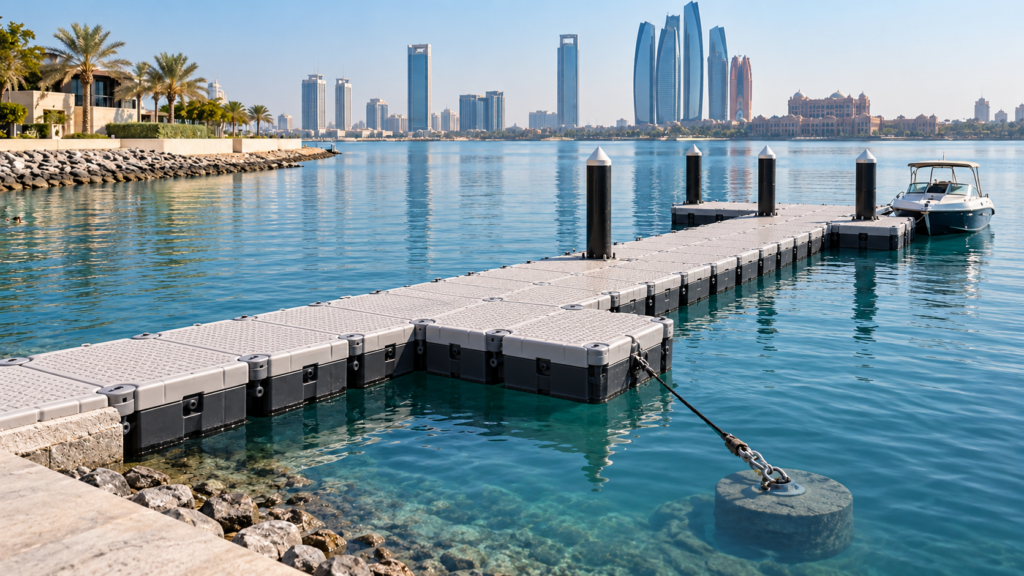
A floating dock can look quite simple from the shore. Put a number of floating modules together, secure them in position, and provide access from land.
In practice, an installation’s success depends far more on what is happening around and below the dock than on the floating platform itself.
Water depth, tides, wind, wave movement, seabed conditions, and the way the dock will actually be used should all be understood before settling on a configuration.
This is particularly relevant in Abu Dhabi, where waterfront conditions can vary considerably from one location to another.
Start with the site, not the dock
It is tempting to begin with the required length and width of the dock. I prefer to look at the site first.
How deep is the water close to shore? What is the depth at the outer end of the proposed dock? How much does the water level change? Is the location sheltered, or is it exposed to wind and vessel movement?
These questions influence not only the size of the dock but also the anchoring system, access arrangement, and overall stability.
A configuration suitable for a protected marina may not necessarily be the right solution for an open waterfront.
Water depth can change the whole arrangement
Water depth should be checked along the proposed length of the dock and not simply at one location.
This becomes particularly important with longer walkways extending from shore. The depth at the outer end may be very different from the depth close to land.
Tidal movement must also be considered. A floating dock naturally rises and falls with the water, while access from the shore remains fixed.
The transition between the two has to remain practical throughout the expected tidal range.
The intended use should determine the configuration
A dock for a private residence will not necessarily have the same requirements as one serving a hotel, marina or commercial waterfront.
A simple boat-boarding platform may need only a walkway and berthing area.
A jet ski application may require dedicated drive-on modules.
Where the dock is used by hotel guests or the public, additional space, handrails, lighting and safer boarding arrangements may be necessary.
Floating work platforms have different requirements again, particularly where personnel, equipment or maintenance activities are involved.
This is where modular floating systems are useful. They allow the layout to be developed around the application rather than forcing every project into a standard arrangement.
Anchoring deserves more attention than it usually gets
The floating platform is the most visible part of the system, but anchoring is often the more critical design consideration.
The correct solution depends on factors such as water depth, tidal movement, seabed conditions, and environmental loads.
Depending on the location, the arrangement may involve piles, chains, elastic anchoring systems, deadweights, or a combination of methods.
The objective is not to make the dock completely rigid. It has to be restrained sufficiently while still being allowed to respond naturally to changes in water level and normal marine movement.
A dock that appears perfectly stable on a calm day can behave very differently when wind, waves, or vessel movement are introduced.
Shore access also needs proper planning
The connection between land and the floating platform is sometimes treated as a secondary item.
It should not be.
Where there is a significant difference between shore level and the water, a gangway or suitable transition arrangement may be required.
The angle should remain practical when the tide changes.
For commercial and hospitality applications, details such as handrails, anti-slip surfaces and clear boarding areas also become part of the overall design.
Maintenance should be considered at the design stage
Modern modular floating docks are designed for marine environments and can offer a relatively straightforward maintenance regime.
However, they are not maintenance-free.
Connectors, anchoring components, access arrangements and areas exposed to repeated vessel contact should be inspected periodically.
One advantage of a modular system is that individual components can usually be attended to without replacing or dismantling the entire installation.
A good installation begins with the right questions
The best floating dock arrangement is rarely determined by dimensions alone.
Before proposing a system, the site conditions, application, access requirements, and anchoring method should be looked at together.
Pristine supplies and installs Candock modular floating dock systems for applications in Abu Dhabi and across the UAE, including private pontoons, marinas, jet ski docks, floating work platforms and commercial waterfront facilities.
The objective is straightforward: provide a system that suits the site and remains practical for the people who will actually use it.
Prometheus George
General Manager
Pristine General Contracting